
Executive Focus: US Midterms
Iran strike likely before 3 January; Hormuz outlook unchanged after vote.
5 November 2026
Highlights
Our call. A Democratic House and Senate, as we expected, leaves President Trump a two-month window to strike Iran again, most likely mid-November to mid-December. From 2027 a Democratic Congress makes a sustained war harder to fund without making a deal more likely. Our base case of a gradual Hormuz recovery from March 2027 holds.
- A strike before 3 January is our base case. A limited strike, no ground war, blockade and sanctions continue. Any disruption shorter than the last round.
- 2027: a harder war, not an easier deal. A Democratic Congress tightens funding gradually. Iran's demands stay unacceptable to legislators of either party. Our view is unchanged.
- Energy policy: little near-term change. Permitting, leases and LNG export approvals stay with the administration. New fossil-fuel initiatives get harder and slower.
The election matters through Iran, not through energy policy
The Democrats have taken both the House and the Senate and gained five governorships. This is the result we expected and flagged in the last Chairman's Corner.
For energy markets, the main channel through which the result affects policy is Congress's say over the Iran conflict, not energy policy directly.
Trump has a two-month window before Congress is seated
The new Congress is sworn in on 3 January 2027. Until then the outgoing Republican Congress keeps full legislative and budgetary authority, and the President faces no major headwind from Capitol Hill.
After 3 January the constraints build gradually rather than all at once. The President keeps his veto. The Democratic majority's tools are the War Powers Resolution, control of military funding and the oversight committees. Their bite grows each time the administration needs Congress to approve more money for the conflict. Much also depends on President Trump's own plans for the rest of his term and on how Republicans react to the result.
Enjoying this report? Join our mailing list.

Join our mailing list to have more reports and insights like this delivered straight to your inbox.
Iran: a strike in the window is more likely than not; our 2027 house view changes little
We expect the President to use the two-month window to strike Iran again, to weaken it further and add pressure towards a deal. The strike is meant to add pressure, not to end the conflict, so the blockade and sanctions stay in place during and after any strike, which we expect to be over by the end of the year.
Fig 1: Two scenarios for the window to 3 January 2027
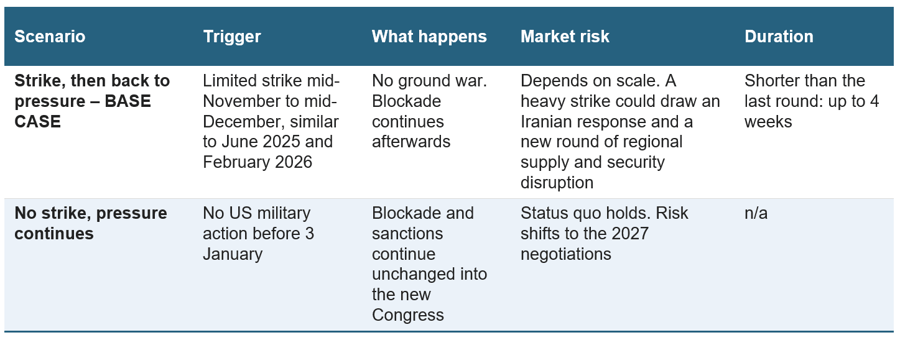
A strike is more likely than not, but only a heavy strike with Iranian retaliation would move our March 2027 recovery assumption.
Source: FGE NexantECA
Note: Window runs from publication to 3 January 2027, when the new Congress is sworn in.
Any disruption after a strike should be shorter-lived than the last round. Gulf operators have built resilience, and shipping has shown it can find workarounds and restore operations quickly.
In 2027 a Democratic Congress lowers the chances of sustaining a war with Iran through the year and strengthens Iran's negotiating position. But Iran's list of demands remains long and, in our view, unacceptable to US legislators of either party. The memorandum of understanding previously on offer still looks a long way off, so we see no material change to our house view.
Hormuz: the risk sits before 3 January; the March 2027 recovery holds
Whether the current Hormuz flow status quo holds through 4Q26 is now the biggest uncertainty in our one-year outlook. The picture for 2027 is becoming clearer, but the next two months carry the greatest escalation risk.
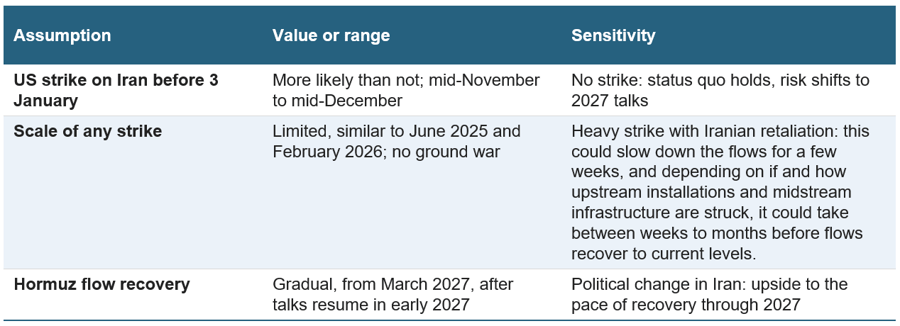
Our assumption of a gradual recovery in flows from March 2027 was built around the midterms. With the election behind us, we expect talks to resume in early 2027, even though a full deal remains distant, and flows to rebuild gradually from there. Continued economic pressure on Iran from the blockade adds upside risk to that recovery through 2027, as the chance of a major political change in Iran rises.
The election result is consistent with that timeline, so we are not changing our base case. A strike and Iranian retaliation in the two-month window would be the main test.
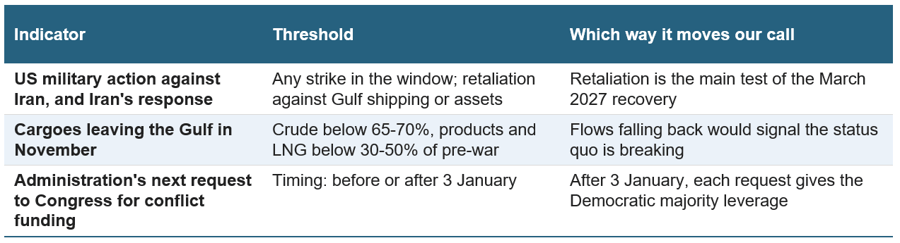
Flows are improving but remain fragile. Crude flows through Hormuz have recovered the most, to around 65-70% of pre-war levels in October, with products and LNG at around 30-50%. Flows recovered even though October was the month when attacks and incidents on vessels peaked.
US energy, trade and foreign policy: no major change for a year or two
We do not expect a major change in the next year or two on tariffs, Russia-Ukraine or domestic energy policy. The administration keeps control of permitting, federal leases, sanctions and LNG export approvals. We see no impact on US LNG project approvals or methane rules from the election result alone.
Nor do we expect the Democrats to push sweeping changes on fossil fuels, or to try to roll back the administration's measures restricting renewables. What changes is the path for expanding these policies: new initiatives supporting fossil fuels will be harder to pass and could be slowed significantly.
Longer term: a Democratic president in 2028 keeps three gas questions open
The result most likely signals that Americans are leaning towards a Democratic president in 2028. That keeps three longer-term gas and LNG questions open. Our current reading of each:
US methane rules realigning with the EU regime from 2029, when the EU requirements are due to start. A Democratic administration would likely pursue this, reducing the risk of US cargoes falling foul of EU rules. This result alone does not change methane rules or LNG projects in the near term.
Texas solar and batteries displacing gas-fired peaking demand. Their growing share of peaking demand frees more gas for export and adds economic pressure to shift domestic policy in favour of exports, regardless of who is in office.
Data centres competing with LNG exports for US gas supply. We expect growing political pushback on data centre build-out to limit the risk to LNG feedgas supply.
Assumptions and what we are watching
Fig 2: Assumptions behind the unchanged base case
Source: FGE NexantECA
Fig 3: What could change our view
Source: FGE NexantECA